Averkii Stepanovich Mikulitsyn
Doctor ZhivagoAverkii Stepanovich Mikulitsyn is a former student deported under police supervision, a manager and engineer, and a Social Revolutionary whose political position makes his household vulnerable from both sides of the civil conflict. He is also the father of Liberius, commander of the Forest Brotherhood. When Yurii Andreievich Zhivago and his family arrive at Varykino, Mikulitsyn first sees them as a dangerous burden, then relents and admits them. His brief but consequential appearance joins public ideology to private hospitality: political divisions govern his circumstances, but do not finally extinguish his capacity for kindness.
Identity and Background
Mikulitsyn arrived from St. Petersburg twenty-five years before the account related by Anfim Samdeviatov. He had studied at the Technological Institute before being deported and placed under police supervision. In his new home he found work as manager for Krueger and married one of the four Tuntseva sisters, the eldest. That personal history situates him between an educated, urban past and the provincial household in which the later political conflicts of the novel converge.
His interests and manner are sketched through a few precise details. He had once intended to become a sailor and studied marine engineering. Clean-shaven and seldom without his pipe, he speaks slowly and amiably through his teeth; his pipe has left him with a jutting lower jaw, while his eyes are cold and gray. The genial voice and cool gaze resist a simple reading of him as either welcoming patriarch or political functionary: he can be affable in manner and guarded in judgment.
Family and Political Position
After his first wife died, Mikulitsyn married Elena Proklovna, who had gone directly from school to the altar. His first marriage had produced a son, Liberius, whom his father named in a gesture of devotion to freedom. The unusual name becomes a pointed family inheritance: Liberius grows up to lead an armed revolutionary formation, while his father remains attached to a rival political tradition.
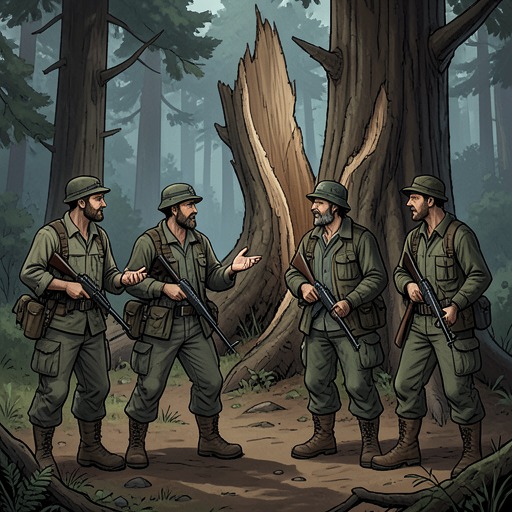
Mikulitsyn is a Social Revolutionary and was elected regional deputy to the Constituent Assembly. His son, by contrast, returned from the war as a lieutenant with three medals and as a thoroughly indoctrinated Bolshevik delegate from the front. Samdeviatov identifies him as the commander known as Comrade Forester, the leader of the Forest Brotherhood. The father and son are political enemies in theory, but the Forest does not make war against Varykino. Their opposition therefore shapes Mikulitsyn’s precarious standing without turning into a direct family battle in the material presented here.
The Arrival at Varykino
Samdeviatov’s account prepares the reader for Mikulitsyn’s response before the Zhivago family reaches his household. He describes him as excessively, almost criminally kind: Mikulitsyn may protest and resist, but eventually gives way, sharing even his last crust of bread. The arrival tests this characterization. Faced with the guests, he asks why they have come to a place where bread is scarce and the Whites are not, and why they have chosen his household in particular. His questions make the practical danger plain rather than disguising it as easy generosity.
The guests’ embarrassment is palpable, and Mikulitsyn’s first reaction is astonishment and distress. He warns that taking them in imposes a serious responsibility on him. Elena Proklovna reinforces the strain, and he tells her not to interrupt before acknowledging that she is right. His protest is not merely a display of temper: he sees himself exposed to danger because of his political identity and his son’s. Those who resent the Forest’s popular Bolshevik commander can make his family answer for Liberius; others can question why Mikulitsyn was elected to the Constituent Assembly.
He describes himself as caught between two fires, with no one to turn to, and fears that sheltering the newcomers could put him before a firing squad. That fear reveals how civil conflict enters the household: even an act of refuge can be interpreted as political allegiance, while his family connections make neutrality impossible. The newcomers are not the only burden; they arrive in a home already strained by competing accusations.
Relenting and Narrative Significance
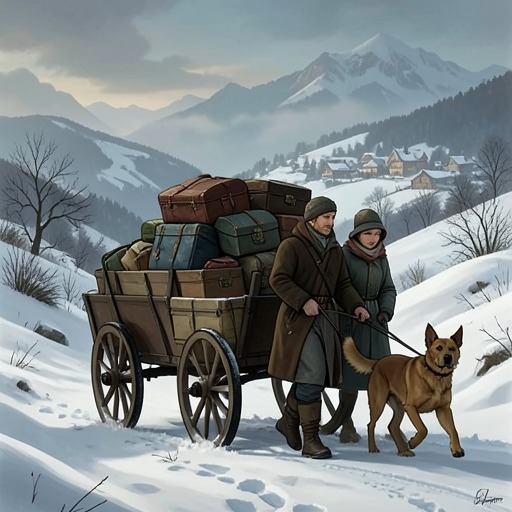
A little later, Mikulitsyn relents. He refuses to continue squabbling in the yard and orders the party inside, while admitting that he cannot see what good will come of it. His caution remains—he proposes that they stay first in the palm room beside the study, with some place in the park to be considered later—but he does not send them away. He invokes the distinction between human beings and heathens, then calls for Bacchus to help carry the guests’ belongings. Bacchus’s observation that the family has only little bundles and not a single trunk underscores their depleted circumstances at the moment Mikulitsyn chooses to receive them.
The change from refusal to shelter gives action to Samdeviatov’s portrait of excessive kindness. Mikulitsyn does not become unafraid or politically secure; he recognizes the risk and accepts it anyway. In this encounter, generosity is neither effortless nor abstract. It takes the form of letting endangered strangers cross the threshold, finding them provisional space, and directing that their few possessions be brought inside.
Mikulitsyn’s divided political position also makes his household a small-scale image of the larger conflict. His son represents the revolutionary army’s Bolshevik power, while Mikulitsyn himself belongs to the Social Revolutionary tradition and the elected Constituent Assembly. Their political opposition coexists with the fact that the Forest does not attack Varykino. By receiving the Zhivago family despite the danger, Mikulitsyn reveals a form of conduct that cannot be reduced to party labels: he is vulnerable to history’s divisions, yet still capable of choosing hospitality.